FEA on the real solid
Modelled parts are now analysed on their real OpenCascade solid. They are meshed into 10-node tetrahedra, with smaller elements at holes, fillets and thin walls. Every result says what it was computed on: B-rep solid, or Screening (envelope) for primitives and catalogue parts.
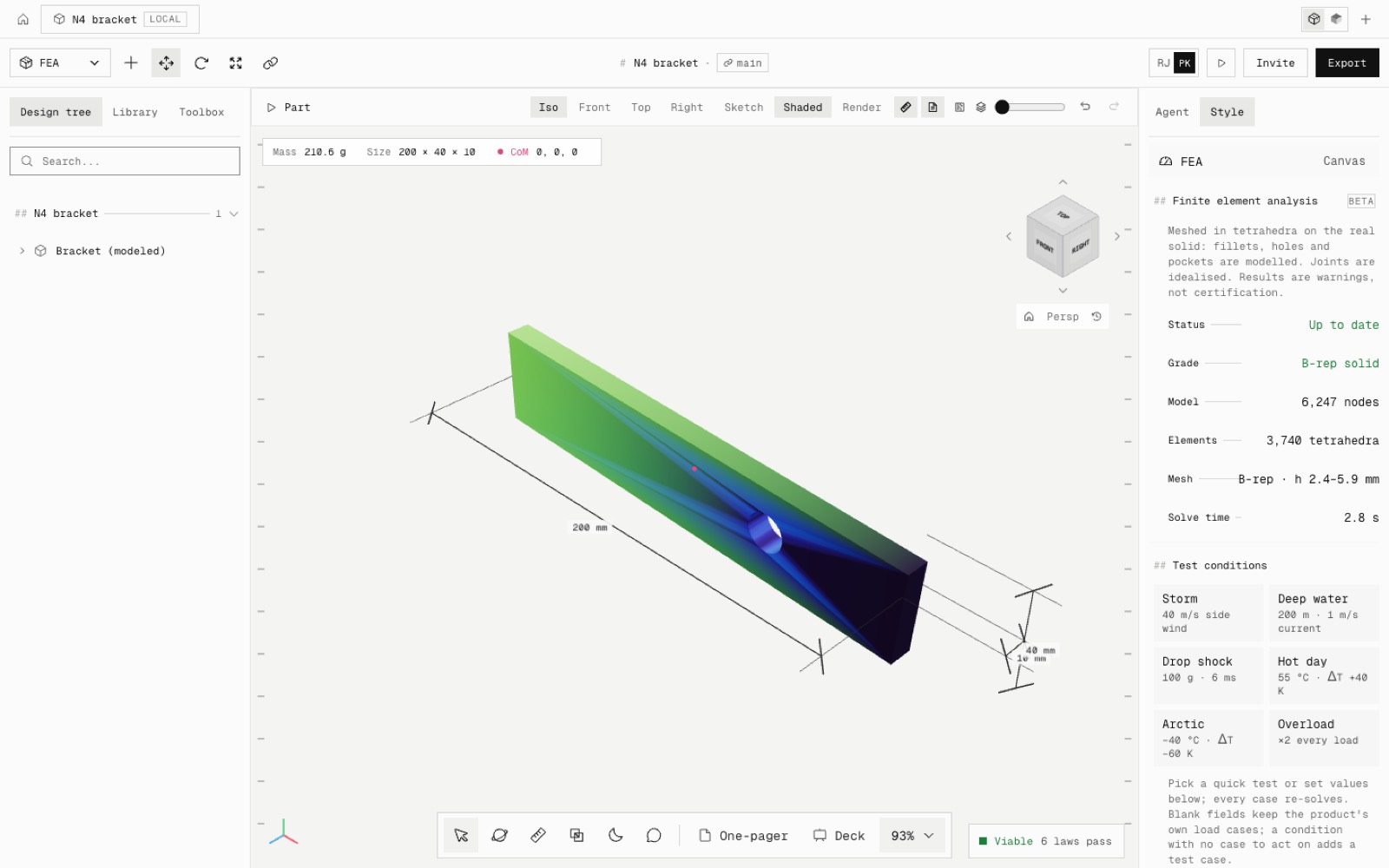
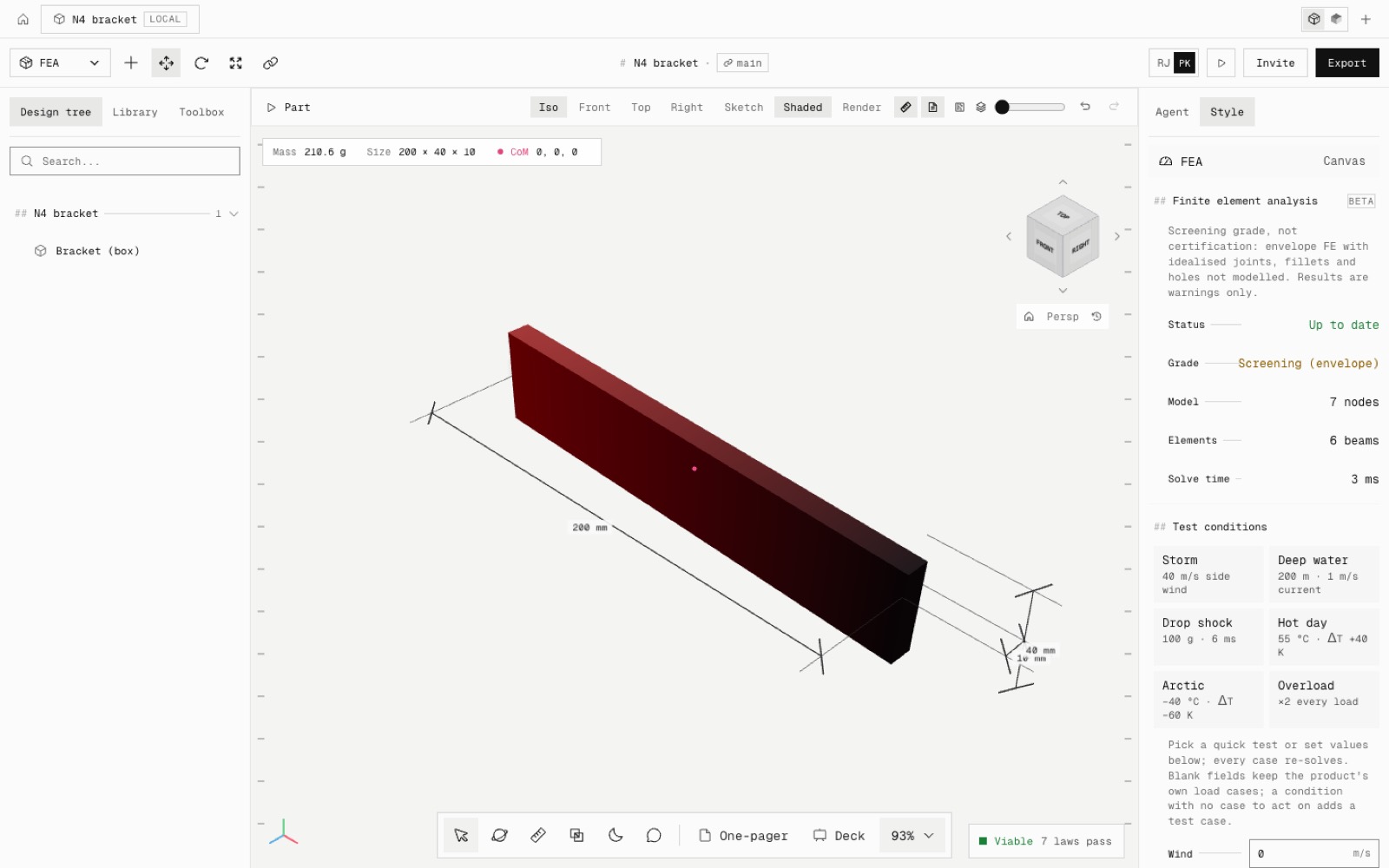
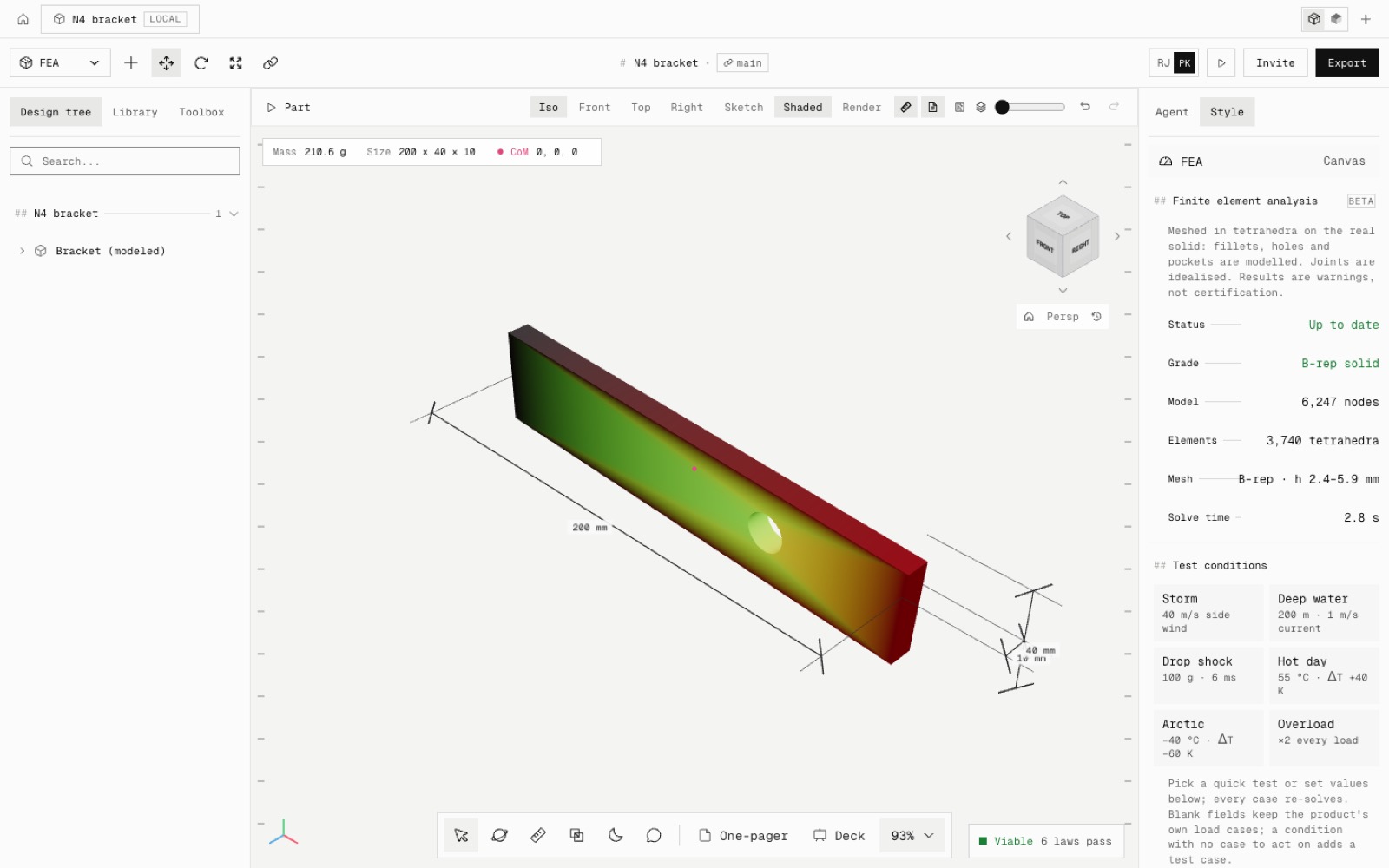
This is step N4 of the North Star plan. The FEA worker meshes the kernel's solid of a modelled part and solves it in the same pipeline as before (loads, supports, joints, static and modal). A part that is not modelled still gets the fast envelope model, labelled Screening (envelope), so no envelope result passes for a real one.
Checked against textbook cases on solids built with the app's own features, in the real kernel. Cantilever deflection is within 1% of Timoshenko and bending stress within 2% of M·c/I. A plate with a hole gives Kt 2.45 against Pilkey's 2.506 (0.5% off on a finer mesh). A thick cylinder matches Lamé to 0.07%. The first cantilever mode comes out at 410.8 Hz against 411.3 Hz. A uniform-tension patch test is exact.
The mesh closes the part's skin, every element is valid, and its volume is within 0.2% of the kernel's. Elements are about 4.8× finer at holes and 4.7× finer at R4 fillets than in the core. Meshing takes 0.2 to 5 s in the worker.
Fixed on the way: rebuilding a part's detail geometry shifted the kernel's cached mesh in place, which roughly doubled browser FEA deflections on parts not centred at zero.
Not on solids yet: heat conduction, buckling and shock checks. Stress colours on modelled parts can look streaky, because they are painted onto the display mesh. A few elements under curved faces are flat but valid.
- Added
- Tetrahedral meshing of modelled parts (10-node elements, refined at holes, fillets and thin walls)
- B-rep solid / Screening (envelope) labels on every result
- npm run test:fea-brep
- Fixed
- Cached kernel meshes were shifted in place, doubling FEA deflections on off-centre parts
- Try it
Model a bracket, open Simulation and run a static case: the result says B-rep solid.
Open Speed- Shipped in
5d18972